
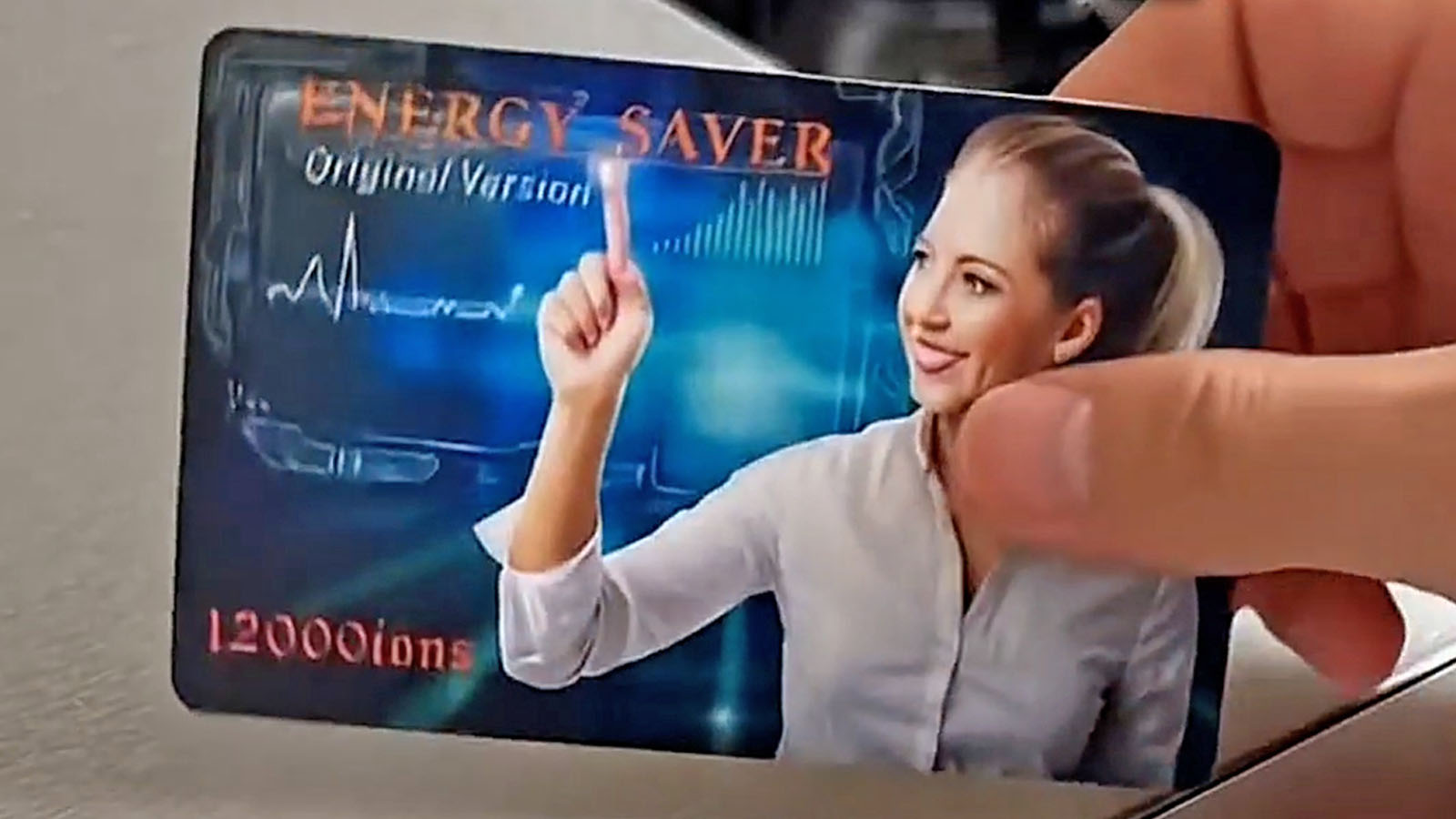
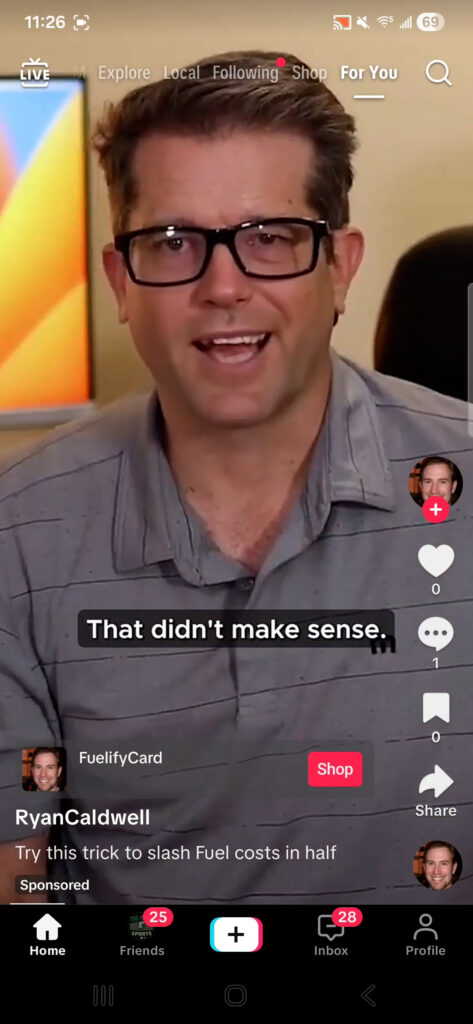
Modern scammers deployed a deceptive campaign for the Fuelify Card, but as this Fuelify Card review shows, the product is a dangerous fraud. The scheme relied on artificial intelligence to fabricate a persona named “Marcus,” who supposedly owned “Marcus Auto Repair” in downtown Phoenix. This digital character claimed to have discovered a secret to doubling fuel mileage by simply placing a thin card near a vehicle’s fuel door. This narrative served as the hook for a scam that fleeced consumers in two distinct stages. First, the company sold a functionally useless piece of plastic labeled as an “Energy Saver.” Second, the checkout process enrolled victims in a secret, high-cost monthly membership.
The fraudulent promotional material featured a man in a shop setting with a distorted BMW logo on his shirt and illegible text on his name tag. This “Marcus” character spun a tale about a client named Mr. Patterson and his 2014 Ford F-150. According to the AI-generated script, the truck achieved an impossible 940 miles on three-quarters of a tank of gas. The video used deepfake technology to sync audio with a real person’s face, though the individual pictured likely had no knowledge of the product. These TikTok ads successfully bypassed content filters to reach millions of budget-conscious drivers looking for a Fuelify Card for gas.
The Science of Snake Oil: Why the Fuelify Card Failed
Automotive experts quickly dismissed the claims made by the creators of the Fuelify Card. The product supposedly worked by “optimizing” fuel through external contact or proximity to the fuel tank. However, no physical mechanism exists where a plastic card can alter the chemical composition of gasoline or the mechanical efficiency of an internal combustion engine from outside the vehicle. The “Marcus” character used buzzwords like “fuel injectors,” “oxygen sensors,” and “engine compression” to sound authoritative, yet the actual product lacked any electronic or mechanical components. It functioned purely as a psychological tool to convince buyers they purchased a high-tech solution.
The imagery used in the advertisements further proved the deception. Close-up shots of the card showed nonsense characters and illegible text, which are common hallmarks of AI-generated images. One specific image contained the text “Zo” and “7 Vietnam,” which had no relevance to automotive performance or fuel savings. Because the technology behind the card did not exist, the physical product arrived as a simple laminated strip or a plastic rectangle with no internal circuitry. Buyers who searched for Fuelify Card reviews found no legitimate evidence of improved gas mileage, as the laws of physics do not allow a static card to double a vehicle’s range.
The Hidden Aviroo Home Membership Trap
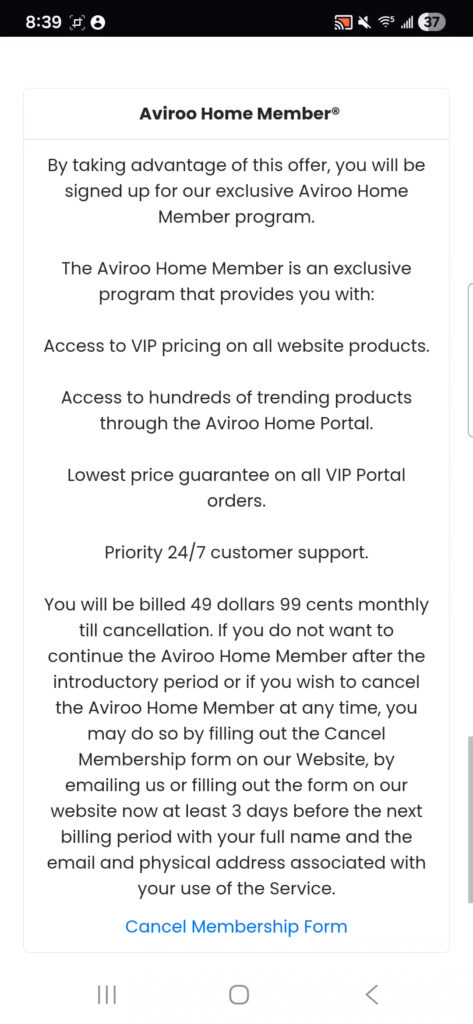
The most damaging aspect of the Fuelify Card scam involved the checkout process on the website aviroohome.com. After clicking through a landing page at dailysavvybuys.com, users landed on a store that appeared to offer a “50% off” discount. While the card itself cost a relatively small amount, the scammers hid a “VIP portal” subscription in the fine print. This “Aviroo Home Member” subscription billed customers $49.99 every month. The website designers purposefully made the membership information difficult to find, placing it at the very bottom of the mobile view in a format that did not look like a clickable link.
Many victims did not realize they had joined a subscription service until they checked their credit card statements weeks later. The billing often appeared under names like “Aviroo Home” or related shell companies based in Hong Kong. These Facebook or Instagram ads directed traffic to a site that prioritized credit card harvesting over product delivery. The scammers banked on the fact that many consumers do not scrutinize every line item on their monthly statements, allowing the $49.99 charges to accumulate over time. This secondary layer of the fraud turned a one-time snake oil purchase into a recurring financial drain.
Fake Reviews and Misleading Trust Scores
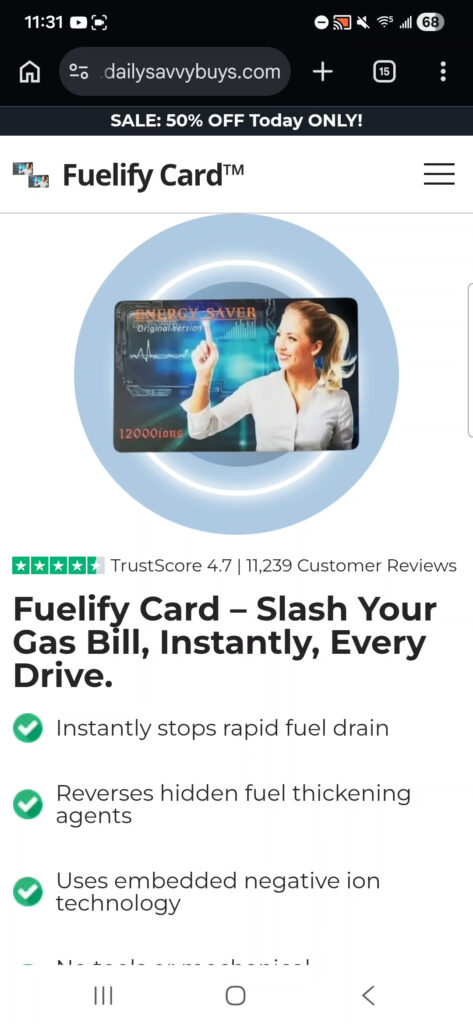
To build unearned credibility, the Fuelify Card websites featured fabricated accolades. The landing pages claimed a “TrustScore” of 4.7 out of 5 and displayed green squares mimicking the branding of popular review platforms. However, these were static images rather than live integrations. The site also falsely claimed endorsements from NBC, ABC, CBS, Fox News, USA Today, and Digital Journal. None of these news organizations ever ran segments or articles supporting the Fuelify Card as a legitimate gas-saving device. Instead, the scammers stole logos to create a “halo effect” of trustworthiness around their fraudulent product.
Legitimate FuelifyCard reviews and complaints did not exist on the product’s own website. Every testimonial featured an AI-generated headshot and a generic story about saving hundreds of dollars at the pump. These fake reviews mirrored the “Marcus” AI video in their lack of specific, verifiable details. While the scammers worked hard to flood the internet with promotional content, they could not hide the reality of the product’s failure. Concerned consumers can often find credible information by checking the BBB website. Additionally, shoppers should verify claims on Trustpilot and Consumer Reports before entering payment details on unfamiliar sites. Those who have already lost money should immediately report the fraud to the FTC.
How to Identify AI-Generated Scams
The Fuelify Card campaign represented a growing trend of AI-integrated fraud. “Marcus” the mechanic served as a digital puppet designed to lower the viewer’s guard. To spot these scams, users should look closely at any text within the video. In the Fuelify ads, the letters on the shop walls and the logos on the mechanic’s uniform appeared blurry or shifted shape between frames. These “artifacts” occur because current AI video models cannot maintain perfect consistency with text and symbols. If a video spokesperson claims to have a “secret” that oil companies or the government are trying to hide, it almost certainly indicates a fraudulent offer.
Furthermore, the high-pressure tactics used in the Fuelify Card ads—such as “limited stock” and “50% off for today only”—pushed viewers to make emotional decisions rather than logical ones. The scammers relied on the “too good to be true” nature of the product to distract from the suspicious technical details. When a product promises to double the efficiency of a complex machine like an F-150 with a simple sticker or card, it bypasses all known engineering principles. By educating themselves on these AI markers, consumers can better protect their bank accounts from the Aviroo Home membership trap and other similar fuel-related schemes.
Protecting Yourself from Recurring Billing
For individuals who already provided their information to aviroohome.com, the situation required immediate action. The website provided a “cancellation” page, but many users reported that submitting the form did not stop the monthly $49.99 charges. Online product scammers often use these forms to confirm that an email address is active, which can lead to further phishing attempts. The most effective way to end the cycle was to contact the credit card issuer directly. Victims should report the charges as fraudulent and request a new card number to prevent future unauthorized drafts by the Hong Kong-based entities behind the Fuelify Card.
The Fuelify Card scam exploited the financial pressure of high gas prices to sell a fantasy. From the deepfake “Marcus” to the hidden Aviroo Home subscription, every element of the campaign functioned to deceive. No “Energy Saver” card can replace the need for regular vehicle maintenance and efficient driving habits. As scammers continue to use AI to craft more realistic advertisements, skepticism remains the best defense for consumers browsing social media. Always remember that if a product’s primary marketing comes from a video that looks slightly “off” or makes impossible scientific claims, it is almost certainly a predatory scheme designed to capture your credit card information.
Forensic Analysis: Deconstructing the AI “Marcus” Deepfake
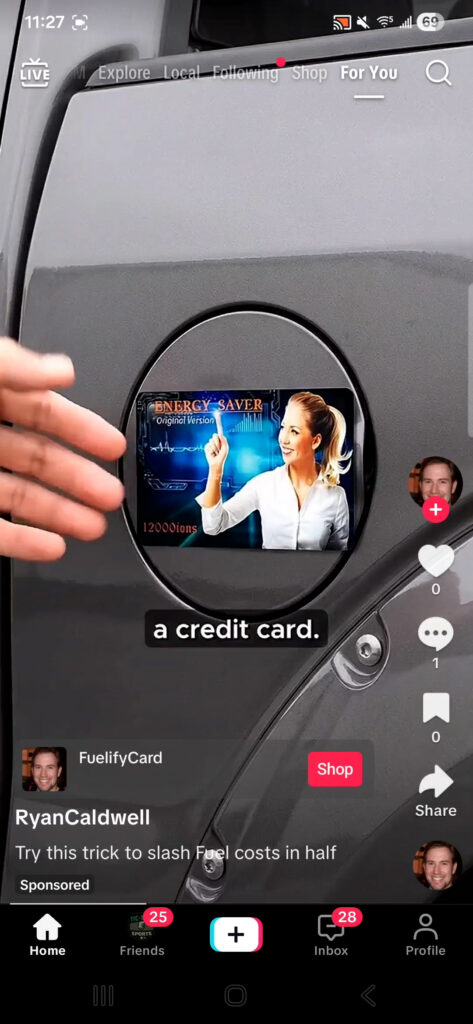
During my investigation into the Fuelify Card promotional videos, I identified several technical “artifacts” that confirm the use of generative artificial intelligence. The primary spokesperson, “Marcus,” serves as a cautionary tale for how scammers use AI to manufacture local trust. While the video appeared professional at a glance, a frame-by-frame analysis revealed significant logical and physical inconsistencies that human actors do not produce.
First, I examined the shop environment. Fuel-saving device scammers often use “latent space” video generation, where the AI “imagines” a background based on thousands of images of auto shops. In the Fuelify ad, the tools hanging on the walls in the background began to “melt” or morph into the shelving when Marcus moved his head. Furthermore, the BMW logo on his shop shirt was not a static patch; the letters shifted and the circular border warped as the fabric moved. Human eyes are trained to ignore background details, but for those searching for Fuelify Card reviews, these visual glitches are the “smoking gun” of a deepfake.
The audio-visual synchronization provided even more evidence. The “Marcus” character spoke with a perfectly consistent cadence that lacked natural human “micro-stutters,” such as breathing pauses or varied emphasis. When I slowed the video to 0.5x speed, I noted that the lip movements occasionally lagged behind the dental consonants (like ‘T’ and ‘D’ sounds). This occurs because the AI is mapping a synthetic voice over a base video of a different person. By fabricating a “local mechanic” with 13 years of experience in Phoenix, the scammers attempted to bypass the viewer’s skepticism through a false appeal to authority.
The Aviroo Home Shell Company Network
My research into the billing structure of this scam led me to a complex network of international shell companies. The website aviroohome.com is just one of many identical storefronts. These entities often register under generic names like “15520312 Canada Inc.” or use virtual offices located at 30 North Gould Street in Sheridan, Wyoming—a known hub for anonymous LLC registrations. However, the true “nerve center” for the Fuelify Card operation appears to be based in Hong Kong, as evidenced by the merchant processing data on the checkout pages.
This “Rotational URL” strategy allows scammers to stay ahead of bank fraud departments. When a site like Aviroo Home accumulates too many “chargeback” requests from angry customers, the scammers simply migrate the exact same content to a new domain, such as Novari Home or Amero Home. This is why you will not find a long history of FuelifyCard reviews and complaints on traditional consumer sites; the scammers shut down the evidence before it can reach a critical mass. They rely on “Negative Option” billing, where the consumer unknowingly agrees to a $49.99 monthly fee by completing a single purchase. This is a common tactic in TikTok ads because the platform’s rapid-fire interface encourages impulsive clicking over careful reading of terms and conditions.
Debunking the Physics: Why “Energy Saver” Cards are Impossible
To provide a truly comprehensive Fuelify Card review, we must address the underlying “science” the scammers claim to use. The ad suggests that a thin card can be pressed against a fuel tank to improve mileage. From an engineering standpoint, this is a physical impossibility. Modern vehicles operate using a “Stoichiometric Ratio” of exactly 14.7 parts of air to 1 part of fuel. This ratio is hard-coded into the car’s Engine Control Unit (ECU) and monitored by oxygen sensors. A plastic card—regardless of what “ions” or “magnetic frequencies” it claims to emit—cannot physically reach through a steel or high-density polyethylene fuel tank to change the chemical properties of the gasoline inside.
If a $20 plastic card could double the fuel efficiency of a Ford F-150, global automotive manufacturers would have integrated this technology decades ago to meet increasingly strict federal fuel economy standards. Instead, companies like Ford spend billions on hybrid drivetrains, lightweight materials, and advanced aerodynamics to gain even a 5% increase in MPG. The claim that a “secret card” can achieve a 100% increase is a classic hallmark of “snake oil” marketing. These schemes often reappear on social media during periods of high inflation or rising gas prices, targeting individuals who are most vulnerable to financial stress.
How to Stop the $49.99 Monthly Charges
If you have already purchased the card and see “Aviroo Home” on your statement, you must act quickly. Do not rely on the “cancellation form” on their website. Scammers often use these forms to collect “active” email addresses for future Facebook or Instagram ads. Instead, call your bank and request a “Merchant Block” specifically for Aviroo Home or any related Hong Kong-based entities. In many cases, the only way to fully guarantee that the $49.99 charges stop is to cancel your current credit card and request a new one with a different number.
You should also document the fraud by taking screenshots of the misleading ads and the checkout page. This evidence is vital when disputing the charges with your bank. While the scammers may offer a “20% partial refund” if you agree to keep the product, this is a trap designed to prevent you from filing a formal chargeback. A formal chargeback hurts the scammer’s “merchant health” and can eventually lead to their payment processor shutting them down. For further assistance, consumers can consult the BBB or check for similar stories on Trustpilot. Always remember to search for the product name alongside keywords like “scam” or “membership” on Consumer Reports before buying. Finally, help the authorities track these networks by filing a report at the FTC website.
Digital Footprint: Tracking the Fuelify Domain Registration
When I analyzed the domain registration data for the websites involved in this scheme, I found several classic “red flags” that indicate a short-lived fraudulent operation. Legitimate retail companies typically register their domains for five to ten years to show stability to search engines and payment processors. In contrast, the domain for aviroohome.com was registered for only a single year. This “burn-and-turn” strategy allows the scammers to abandon the site once the volume of scams reported to banks makes it impossible to process further credit card transactions.
Furthermore, the registration for dailysavvybuys.com—the site hosting the fake Fuelify Gas Card reviews—was masked using a privacy proxy service. While many legitimate site owners use privacy protection, scammers use it specifically to hide their connection to previous “fuel saver” or “energy saver” websites that were shut down for fraud. During my review of the server’s IP history, I discovered that these domains share the same hosting infrastructure as several other “mirrored” scam sites. These sites use identical layouts but swap the product name from “Fuelify” to “EcoFuel” or “GasSaver Pro” depending on which keyword is currently trending on social media.
The lack of a verifiable physical address in the United States is perhaps the most glaring piece of evidence. The “About Us” sections of these sites use generic, AI-written text that mentions a “commitment to the environment” but provides no corporate headquarters or phone number. Any customer service emails sent to the listed addresses typically return “undeliverable” or lead to an automated response designed to delay the victim from filing a dispute. This lack of transparency is a direct violation of standard retail practices and further proves that the Fuelify Card is a predatory operation designed for maximum financial extraction in a minimum amount of time.
Fuelify Card Frequently Asked Questions (FAQ)
Is the Fuelify Card a legitimate gas-saving device?
No. The Fuelify Card is a scam that uses AI-generated deepfakes and fake reviews to sell a non-functional plastic card. There is no scientific evidence that a plastic card can improve a vehicle’s fuel efficiency or mechanical performance.
How does the Fuelify Card “double scam” work?
The scam operates in two stages: first, victims are charged for a useless physical product. Second, the checkout process on sites like aviroohome.com secretly enrolls customers in a $49.99 monthly “VIP” subscription fee hidden in the fine print of the website.
Who is “Marcus” from the Fuelify Card commercials?
“Marcus” is an AI-generated deepfake persona. The “Marcus Auto Repair” shop and the spokesperson do not exist in reality; they are digital fabrications designed to create a false sense of local authority and trust among drivers.
How can I cancel the Aviroo Home monthly subscription?
To stop the recurring $49.99 charges, you should contact your credit card issuer immediately to request a merchant block or a card replacement. Do not rely on the scammers’ website cancellation forms, as these are often used to harvest active email addresses for further phishing.
What should I do if I already bought a Fuelify Card?
If you have provided your payment information, monitor your bank statements for charges from “Aviroo Home” or similar entities. Report the fraudulent activity to your bank and file a formal complaint with the FTC at reportfraud.ftc.gov.
Important Note: I generated this article with the help of AI.