
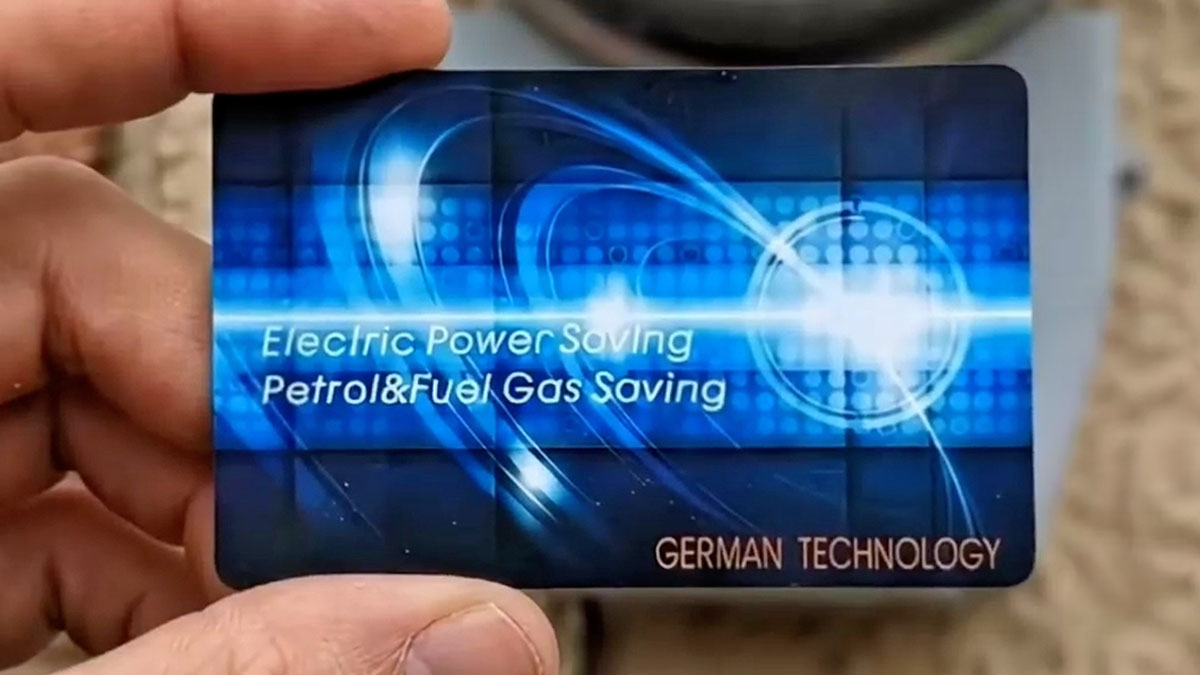
The digital landscape in March 2026 has been flooded with a highly sophisticated, multi-layered fraud known as the Electrify Card. Marketed through aggressive social media campaigns, particularly on TikTok and Meta platforms, this scheme uses cutting-edge artificial intelligence to fabricate a narrative that appeals to homeowners struggling with rising utility costs. The campaign centers on a “miracle” device—a thin, credit-card-sized insert—that purportedly slashes electricity bills by nearly 50% simply by being placed near a residential breaker box. However, a deep-dive investigation reveals that the Electrify Card is the flagship product of a “double scam” designed to compromise consumer financial data and lock victims into high-cost, recurring monthly subscriptions without their consent.
Verdict: The Electrify Card is a confirmed scam. It uses deepfake AI to sell a non-functional product and hides a recurring $49.99 monthly subscription through Aviroo Home. There is no scientific evidence it reduces energy costs.
This investigation into the Electrify Card began after a surge in online searches for terms such as “is Electrify Card legit” and “Electrify Card reviews for home.” The marketing material for this product is not merely misleading; it is a meticulously constructed work of fiction. At the heart of the promotion is a “Daniel” character, a purported master electrician who claims to have discovered an industry secret that utility companies are “desperate to hide.” By leveraging the current climate of economic anxiety, the scammers have built a scam that bypasses traditional skepticism through the use of high-production-value digital deceptions and manufactured authority.
Anatomy of the “Double Scam” Strategy
The “double scam” architecture works in two distinct phases. The first phase is the sale of the physical card itself, which is presented as a revolutionary breakthrough in electrical efficiency. Consumers are led to believe they are purchasing a high-tech tool, but they are actually receiving a worthless piece of laminated plastic with no internal circuitry or functional components. The second, and far more damaging, phase occurs during the checkout process on third-party domains like aviroohome.com. Here, the scammers use “dark pattern” web design to hide a $49.99 monthly membership fee, effectively turning a one-time “too good to be true” purchase into a $600-per-year financial drain.
Fabricating Authority: The “Daniel” Persona
To understand the scale of this fraud, one must look at the “Daniel” persona. The promotional videos feature a man identified as the owner of “Daniel’s Electrical Services” in downtown Houston. He claims to have serviced over 4,300 homes since 2012, providing a layer of local credibility intended to disarm viewers. However, “Daniel” does not exist. He is a deepfake AI creation, a digital puppet whose facial movements and voice have been synthesized to deliver a script that sounds like a professional endorsement. This is a common tactic in TikTok scams, where the platform’s fast-paced, vertical video format makes it harder for the average user to spot the subtle glitches inherent in AI-generated content.
The Mrs. Caldwell Narrative: A Manufactured Success Story
The narrative “hook” involves a fictional encounter with a retired school teacher in Phoenix named Mrs. Caldwell. “Daniel” tells his audience that during a routine inspection of her 1998-built home, he discovered her meter was spinning at a “slow, steady crawl” despite her running a full array of modern appliances. He attributes this impossible efficiency to the Electrify Card. This storytelling technique is a classic “red herring,” designed to distract the consumer with a miraculous outcome so they don’t question the scientific impossibility of the device itself. The scammers even go as far as to show “diagnostic meters” in the video that supposedly prove the drop in kilowatt-hour usage, but these readouts are as fake as the person holding them.
Operational Secrecy and Financial Risk
Further analysis of the advertising reveals that the scammers are targeting a global audience, though the product appears to ship from hubs in Hong Kong. The websites used to facilitate these sales, such as ClickCraftReviews and Aviroo Home, are ephemeral—they appear and disappear frequently to evade detection by consumer protection agencies and search engine crawlers. By the time a victim realizes the Electrify Card does not work, the original ad they clicked on has often been replaced by a new iteration of the same scam under a different name. This “churn and burn” strategy is a hallmark of modern international fraud syndicates who specialize in high-volume, low-friction e-commerce scams.
The danger of the Electrify Card extends beyond the initial loss of money. Because the checkout process is hosted on unverified domains like aviroohome.com, consumers are handing over their full name, home address, and credit card details to an entity with ties to overseas criminal networks. The $49.99 monthly charge is often labeled on bank statements as “Aviroo Home VIP” or “Membership Portal,” terms that are intentionally vague to prevent immediate recognition by the account holder. This investigation has confirmed that these charges are virtually impossible to cancel through the website’s own “cancellation form,” which exists only to gather more data for potential phishing attempts.
The Failure of Platform Vetting
The persistence of these ads on platforms like TikTok and Meta highlights a massive failure in automated ad-vetting processes. Despite the obvious signs of AI manipulation—such as the “Daniel” character’s morphing ears and the garbled text on his “Electiocien” shirt—the ads are allowed to run as long as the scammers continue to pay. This creates a “pay-to-play” environment where fraudulent content is given the same visibility as legitimate businesses, leaving the burden of verification entirely on the consumer. This report serves as a definitive warning: there is no such thing as a card that can bypass the laws of physics to lower your electricity bill. The Electrify Card is a digital illusion designed to facilitate a very real theft.
Conclusion: A New Frontier of AI-Assisted Fraud
As we move into the forensic breakdown and technical debunking sections of this report, it is important to remember that the scammers’ greatest weapon is the “double scam” structure. They aren’t just selling you a fake product; they are selling you a false sense of security while they siphon funds from your bank account every thirty days. If you have seen these ads or were tempted by the “Daniel” spokesperson, understand that the entire production—from the teacher in Phoenix to the shop in Houston—was generated in a computer lab with the sole purpose of deception. The Electrify Card represents the new frontier of AI-assisted consumer fraud, and vigilance is the only effective defense.
Forensic Analysis: Deconstructing the “Daniel” AI Persona
A granular forensic breakdown of the Electrify Card promotional footage reveals undeniable evidence of deepfake AI technology at work. While the scammers attempt to present “Daniel” as a trustworthy, local Houston electrician, the digital artifacts left behind by the generative algorithms tell a different story. These errors are common in high-volume TikTok scams, but they require a careful eye to identify before the “hook” of the narrative takes hold.
The “Electiocien” Wardrobe Malfunction
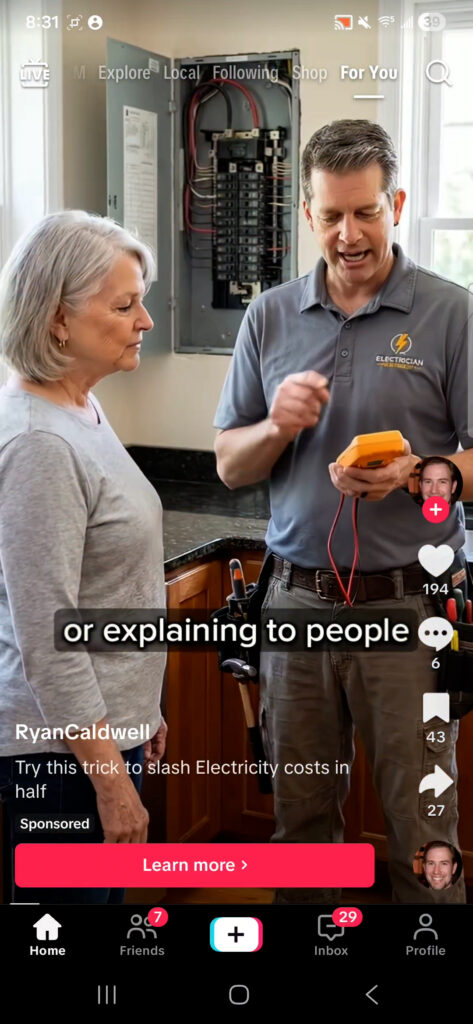
One of the most glaring forensic “tells” appears on “Daniel’s” clothing. In an effort to establish professional authority, the AI attempted to generate a standardized work shirt with a name and title. However, current generative video models often struggle with consistent, legible text. Upon freezing the frame, the title on his shirt does not read “Electrician,” but rather “Electiocien.” This type of linguistic gibberish occurs because the AI predicts the visual “shape” of letters rather than understanding their meaning, resulting in a nonsensical misspelling that no professional business would ever permit on a uniform.
Anatomical Glitches and Morphing Features
The “Daniel” character exhibits several physiological anomalies that are characteristic of AI-generated human subjects. Most notably, his left ear undergoes a series of disturbing transformations throughout the video. As he moves his head, the AI struggles to maintain the geometry of the ear, causing it to morph, flatten, and change size. Additionally, the character appears to be wearing an earring that intermittently floats in front of his earlobe or passes directly through the skin without a visible piercing. These “masking errors” occur when the AI loses track of the depth and placement of objects in a 3D space, a common failure in deepfake synthesis.
The Deception of Fake Social Proof
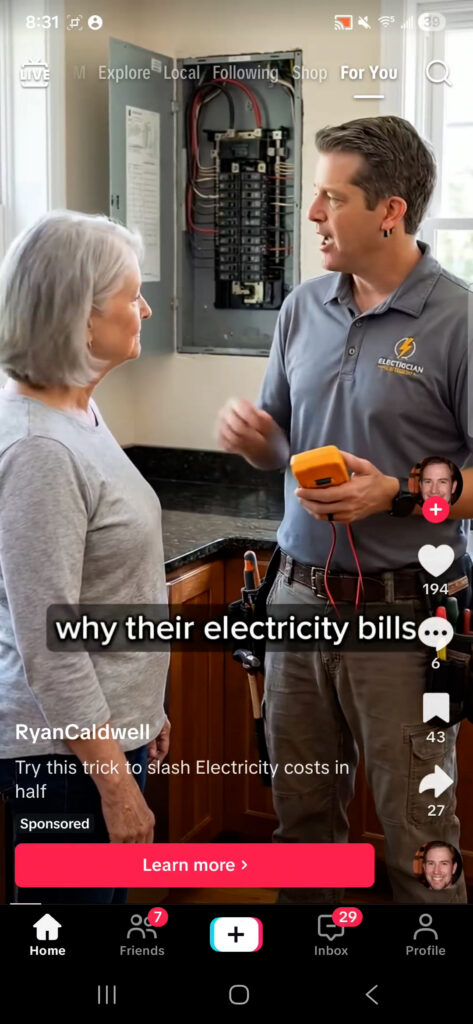
To bypass consumer skepticism, the scammers utilize “bridge sites” like clickcraftreviews.com to host fabricated testimonials. These pages are designed to mimic legitimate third-party review platforms, prominently displaying a “TrustScore” of 4.7/5. This is a deliberate attempt to impersonate the branding and scoring system of Trustpilot. By presenting a near-perfect rating on a site that looks like an independent authority, the scammers provide a false sense of security to homeowners who are performing a quick search to see if the product is legitimate.
The “Energy Saver Originol” Artifacts
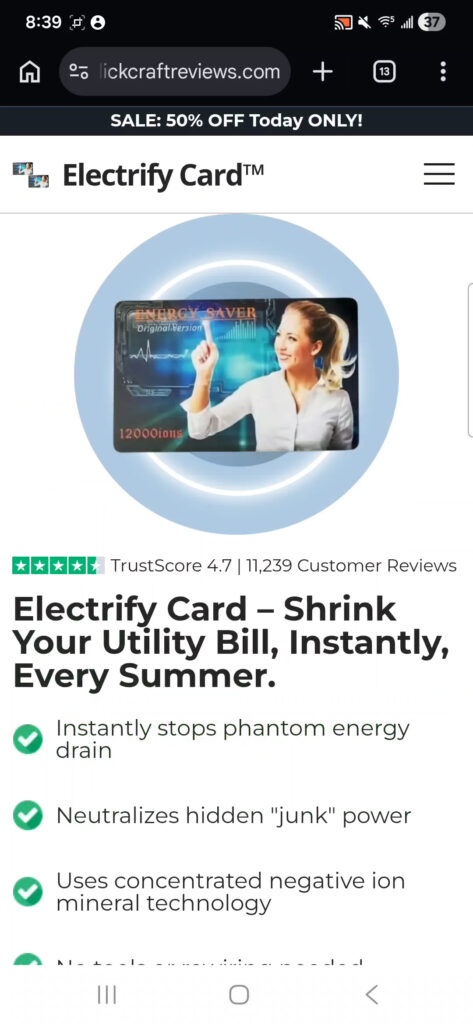
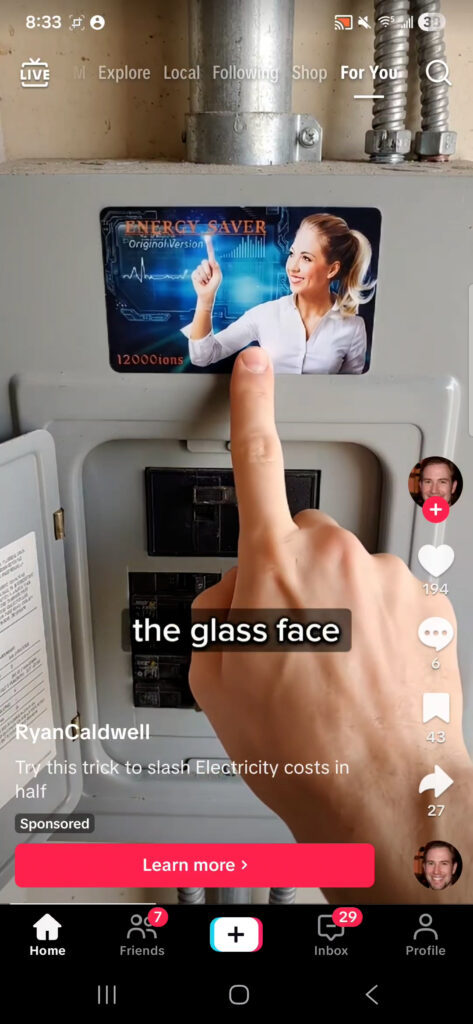
The forensic evidence extends to the physical product shown in the video. When the “Daniel” persona holds the Electrify Card up to the camera, the text on the card is riddled with AI-generated errors. The card is labeled as the “Energy Saver Originol Version,” utilizing a blatant misspelling of the word “Original.” Furthermore, the typography on the card is inconsistent, with letters that seem to vibrate or shift slightly between frames. The hand holding the card also displays “smooth-skin” filtering—a lack of realistic skin texture, pores, or knuckles—which is a byproduct of the AI’s tendency to over-average human features into a plastic-like finish.
Environmental Inconsistencies
Beyond the spokesperson, the setting of the ad lacks basic real-world logic. The video purports to show a “routine panel inspection” in Mrs. Caldwell’s kitchen, yet the electrical breaker box is mounted in a location that violates standard residential building codes and practical logic for a home built in 1998. The internal components of the breaker box shown are also “low-detail” digital assets; the switches lack realistic shadows, and the wiring appears as a blurred, singular mass rather than individual insulated lines. These environmental shortcuts prove that the entire “Daniel’s Electrical Services” shop is a digital fabrication, not a real place of business in Houston or anywhere else.
By identifying these forensic markers, consumers can see through the manufactured “Experience and Expertise” the scammers are trying to project. This video is not a testimonial from a seasoned pro; it is a calculated digital puppet show designed to lead victims into the next stage of the scam: the billing trap.
Electrical Engineering vs. Marketing Fiction: Why the Card Fails
The marketing narrative for the Electrify Card relies on a fundamental misunderstanding—or intentional distortion—of how residential electricity is measured and billed. Scammers often use technobabble like “Power Factor Correction,” “cleaning dirty power,” or “ion stabilization” to convince homeowners that electricity is being wasted. While these terms have a basis in industrial engineering, they are entirely irrelevant to the way a standard home functions. In reality, there is no physical mechanism by which a thin plastic card can reduce the amount of energy consumed by your appliances.
The “Power Factor” Misconception
The core “grain of truth” that scammers exploit is the concept of Power Factor (PF). In large industrial factories with massive motors and heavy machinery, the voltage and current can fall out of sync, creating “reactive power.” Industrial facilities are sometimes billed for this inefficiency and use large, expensive capacitor banks to correct it. However, residential homes are only billed for “Real Power” (measured in Kilowatt-hours). Your utility meter specifically ignores the reactive power that these scam cards claim to “fix.” Even if the Electrify Card contained a functional capacitor—which it does not—it would have zero impact on your monthly utility bill.
Why a Passive Card Cannot Alter Current
Electrical current is the flow of electrons through conductive wiring. To influence this flow, a device must be integrated into the circuit. The Electrify Card is a passive, non-conductive object. Placing a piece of plastic near a metal breaker box or sticking it to the glass of a meter (as seen in the “Daniel” video) is the electrical equivalent of putting a sticker on your garden hose and expecting the water to flow faster. As noted in independent consumer reports, these devices cannot “straighten” or “filter” electricity because they are not part of the electrical path.
The Safety Risks of “Originol” Technology
Beyond being a financial scam, these unverified “energy savers” often bypass basic safety certifications. Genuine electrical components must undergo rigorous testing to ensure they do not cause electrical fires or interference. The Electrify Card, typically manufactured in unregulated facilities in Hong Kong, carries no legitimate safety ratings. Worse yet, similar “negative ion” cards have been found to contain trace amounts of radioactive materials like thorium to justify their “ion” claims, posing a potential health hazard if kept in close proximity to residents. Scientific analysis by organizations like the FTC has consistently shown that “power saving” gadgets are modern-day snake oil with no measurable benefit to the consumer.
The Aviroo Home Billing Trap: How the $49.99 Subscription Works
While the initial cost of the Electrify Card is presented as a one-time purchase, the true financial threat lies in a hidden recurring charge. During the checkout process on aviroohome.com, victims are unknowingly enrolled in a “VIP Membership” program. This is a classic “negative option” scam, where the absence of a “no” is treated as a “yes.” According to reports from the BBB Scam Tracker, the site often advertises a “free” trial or membership that quietly converts into a **$49.99 monthly fee** after just a few days.
Dark Patterns and Hidden Buttons
The scammers use “dark patterns”—manipulative user interface designs—to hide these terms from the average consumer. On the mobile checkout page, the link for the “Aviroo Home Member” details is located at the very bottom, far below the “Complete Purchase” button. It is designed to look like plain text rather than a clickable button, ensuring most users never see the terms of the agreement. Once clicked, the fine print reveals that the buyer will be billed $49.99 every 30 days for access to a “VIP portal” that offers no tangible value or service. This is a common tactic in TikTok scams, where the goal is to secure the credit card number under a false premise and then initiate recurring drafts.

The Difficulty of Cancellation
Victims who discover the unauthorized charges often find that cancelling the subscription is nearly impossible. The aviroohome.com site provides a “Membership Cancellation” form, but many consumers have reported that submitting this form does nothing to stop the billing. In some cases, scammers respond to emails with threats of legal action or claims that the “contract” is binding, a tactic used to intimidate victims into continued payment. As noted in discussions on banking forums, recurring charges can sometimes bypass a simple “card freeze,” as some major card issuers automatically provide updated card information to recurring merchants as a “service.”
Hong Kong Origins and Shell Entities
Investigation into the billing entities behind Aviroo Home shows ties to shell companies in Hong Kong. Payment statements may show various names, such as “Aviroo Home HK” or even unrelated company IDs like “15520312 Canada Inc.” to obscure the source of the charge. By the time a consumer realizes they have been scammed, the funds are often already transferred overseas, making recovery difficult through standard banking channels. This $49.99 trap is the real profit engine for the Electrify Card operation, far exceeding the money made from the non-functional card itself.
How to Report the Electrify Card Scam
If you have been targeted by the Electrify Card campaign or have already seen unauthorized charges from Aviroo Home on your statement, it is vital to report the activity to the proper authorities. Reporting not only helps law enforcement track the scale of this international fraud but also creates a paper trail that can assist you in disputing charges with your bank. Use the following resources to document your experience with this scam.
1. Federal Trade Commission (FTC)
The FTC is the primary agency responsible for investigating deceptive business practices and “dark pattern” billing traps in the United States. You can file a formal report at ReportFraud.ftc.gov. When filing your report, specifically mention the use of deepfake AI technology in the advertisements and the hidden $49.99 monthly subscription associated with Aviroo Home. This helps the FTC identify patterns and build cases against the overseas entities responsible for these TikTok scams.
2. Better Business Bureau (BBB) Scam Tracker
To warn other consumers in real-time, you should post your experience on the BBB Scam Tracker. Search for “Electrify Card” or “Aviroo Home” to see if others have reported similar issues. Providing details about the “Daniel” persona and the Hong Kong shipping origins helps the BBB maintain an accurate database of active fraudulent operations. This is a crucial step in breaking the cycle of misinformation that allows these scams to thrive on social media platforms.
3. FBI Internet Crime Complaint Center (IC3)
Because the Electrify Card operation involves international wire fraud and unauthorized credit card billing across state lines, it falls under the jurisdiction of the FBI. You can submit a complaint at IC3.gov. Be sure to save any confirmation emails, digital receipts, or screenshots of the deceptive TikTok ads as evidence. The IC3 uses this data to coordinate with international law enforcement partners to disrupt the financial networks used by scammers based in Hong Kong and other offshore hubs.
4. Contact Your Financial Institution
Beyond government reporting, your most immediate priority is securing your funds. Call the number on the back of your credit card and state clearly that you have been the victim of a “subscription scam.” Ask to dispute the charges and request a “merchant block” specifically for Aviroo Home. In many cases, the bank will recommend issuing a new card number to prevent the scammers from using “updater services” to continue the $49.99 monthly drafts.
5. State Attorney General
Beyond federal reporting, consumers should contact their State Attorney General’s Office. Most states have a dedicated consumer protection division that investigates energy-related fraud and ‘negative option’ billing traps like the one used by Aviroo Home.
Electrify Card Frequently Asked Questions (FAQ)
Is the Electrify Card a legitimate energy-saving device?
No. The Electrify Card is a scam that uses AI-generated deepfakes and fake reviews to sell a non-functional plastic card. There is no scientific evidence that a plastic card can improve a home’s electrical efficiency or reduce utility meter readings.
How does the Electrify Card “double scam” work?
The scam operates in two stages: first, victims are charged for a useless physical product. Second, the checkout process on sites like aviroohome.com secretly enrolls customers in a $49.99 monthly “VIP” subscription fee hidden in the fine print of the website.
Who is “Daniel” from the Electrify Card commercials?
“Daniel” is an AI-generated deepfake persona. The “Daniel’s Electrical Services” shop and the spokesperson do not exist in reality; they are digital fabrications designed to create a false sense of local authority and trust among homeowners.
How can I cancel the Aviroo Home monthly subscription?
To stop the recurring $49.99 charges, you should contact your credit card issuer immediately to request a merchant block or a card replacement. Do not rely on the scammers’ website cancellation forms, as these are often used to harvest active email addresses for further phishing.
What should I do if I already bought an Electrify Card?
If you have provided your payment information, monitor your bank statements for charges from “Aviroo Home” or similar entities. Report the fraudulent activity to your bank and file a formal complaint with the FTC at reportfraud.ftc.gov.
Important Note: I generated this article with the help of AI.