
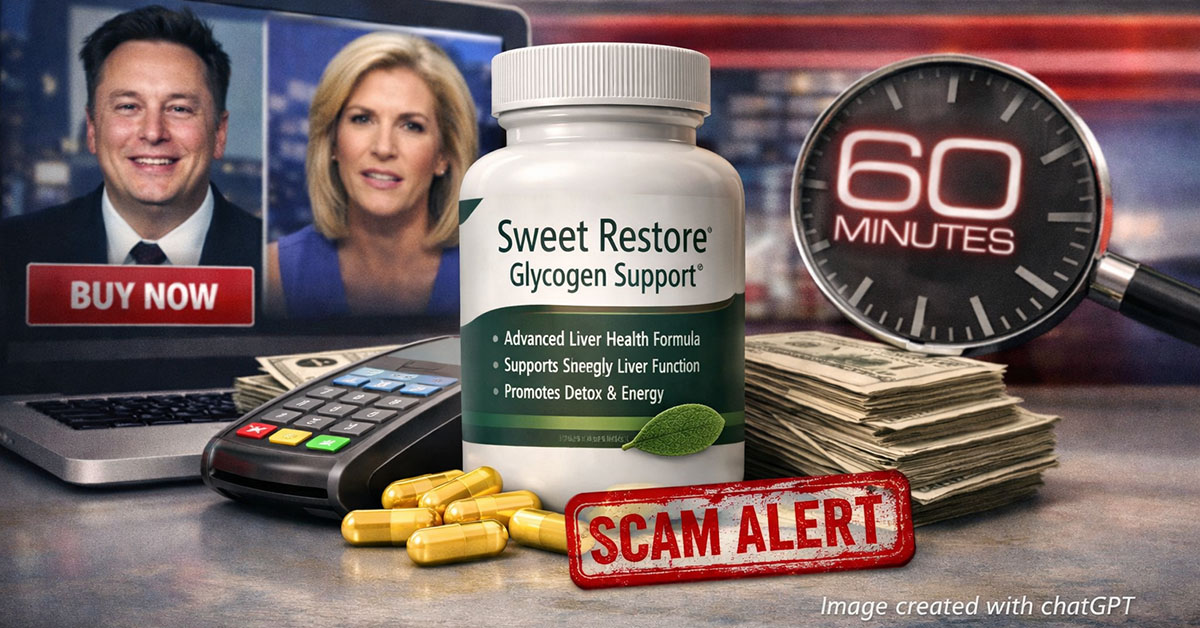
People searched for Sweet Restore Glycogen Support reviews after scam marketing videos circulated online and falsely linked the supplement to Laura Ingraham, Elon Musk and Barbara O’Neill. Those promotions presented a fabricated Fox News-style segment and pushed dramatic liver-related claims to sell Sweet Restore Glycogen Support. No doctors, famous people, hospitals or universities endorsed the product in those ads, and no evidence showed that Fox News aired any report about it. I did not label Sweet Restore Glycogen Support itself a scam. I documented deceptive marketing tactics that appeared to come from affiliates or impersonators using the brand name without clear authorization.
Many consumers searched for Sweet Restore Glycogen Support reviews and complaints because they could not find credible reviews online. That absence created uncertainty and gave deceptive advertising room to spread. The marketing leaned on manipulated video, AI-generated audio and urgent sales language to push purchases through unfamiliar websites. Any unrelated products or companies with similar names had no involvement in this marketing, and consumers should not contact them for refunds or support.
Bottom line in plain English: Consumers should steer clear of medicinal products marketed with questionable or potentially deceptive claims, especially when the product does not appear for sale in their local pharmacies and the company does not clearly identify its true founder, staff or mailing address. Consumers should also be cautious when an unofficial-looking website offers money back guarantee promises or raises the risk of charging monthly subscription fees. In those situations, the safest move is to close the website and make an appointment with a medical doctor. Anyone who already purchased a product after seeing questionable claims should contact their credit card company if they could not reach a legitimate company representative.
What the Sweet Restore Glycogen Support ads claimed
The deceptive promotion opened with a video that copied the look and rhythm of a cable news clip and claimed that Fox News aired a medical breakthrough segment. The video placed Laura Ingraham on screen and paired her image with audio that promoted a supposed cure for liver disease and other chronic liver problems. The narration also used Elon Musk’s name to suggest authority and innovation, then claimed that editors “checked the facts” with doctors and government officials before airing the story. Scammers used those claims to make the pitch sound vetted, official and urgent.
The video pushed a rapid timeline and promised restored liver cells and function in less than 17 hours. It cited bioengineering, nanotech and human cell models and framed the product as a nonprescription alternative to “toxic” pharmacy drugs. It also claimed that pharmaceutical companies wanted to hide the “trick” and that platforms banned Musk’s social accounts after he shared it. The promotion tried to make the viewer feel like they discovered forbidden information that powerful institutions suppressed.
The pitch also invoked Barbara O’Neill and suggested she collaborated on a biological blend that rebuilt liver tissue and restored enzyme balance. The promotion treated her name as medical validation, even though it offered no credible proof of her involvement. The marketing used that name because repeated exposure created familiarity, and familiarity often drove trust in deceptive health advertising.
Where people likely saw the marketing
Scammers often pushed this type of scam marketing through social media advertising, where short-form video spread fast and verification lagged behind. Consumers frequently encountered these pitches in Facebook or Instagram ads that led to off-brand landing pages. Similar promotions also appeared in TikTok ads, where users often watched a clip, clicked a link and reached a sales page within seconds.
Those funnels often followed a familiar pattern. Scammers started with a dramatic video and then pushed a discount and a limited-time offer. They used urgency to keep people from stepping back and evaluating the claims. They also tried to move the buyer away from recognizable retail channels and into checkout pages that made fine print hard to notice.
Why Sweet Restore Glycogen Support reviews did not show up
Consumers searched for Sweet Restore Glycogen Support reviews because they wanted independent information before buying. They did not find credible reviews online, and that gap mattered. A lack of reviews did not prove that the product failed, but it did remove a layer of public accountability that often helped consumers spot patterns, complaints and refund issues.
Deceptive marketers benefited when people could not locate established consumer feedback. They filled the space with fabricated endorsements, sensational claims and borrowed authority from public figures. They also used medical language without providing the documentation that credible medical reporting demanded.
Checkout pages raised VIP and recurring-charge concerns
After the fake news-style video ended, the sales flow presented Sweet Restore Glycogen Support with a steep discount, including a low price next to a slashed higher price. The pitch urged viewers to “claim” a bottle and highlighted an 80% discount to make the offer feel rare. The marketing also used FDA-themed language to imply official approval, even though that wording often confused consumers. FDA registration for a facility did not equal FDA approval of a product.
The ordering process redirected to shopsweetrestore.com, which displayed Sweet Restore Glycogen Support alongside other products and bonuses, including Sweet Restore Cleanse, Sweet Restore Iron, Sweet Restore Keto and ACV gummies and Sweet Restore Potassium. The layout encouraged multi-bottle purchases by framing options as two-month, four-month or six-month supplies. That structure often signaled ongoing billing arrangements, and consumers needed to read every term before submitting payment.
The checkout page also displayed a prechecked “Become a VIP and save 20%” option under the rush-order button. Prechecked add-ons often led to unexpected charges because many buyers clicked through quickly. A consumer who wanted a one-time purchase could still pay for extras if the site bundled them by default. That design choice raised concern because it placed financial risk on the buyer rather than clear consent on the seller.
Refund promises often created risk for supplement buyers
Supplement marketing often promised money-back guarantees, but consumers regularly reported difficulties when they tried to secure refunds after a charge posted. Deceptive marketers counted on that friction. They buried terms in fine print, routed customer service through limited channels or delayed responses until refund windows closed.
In this case, the sales site listed contact details tied to Sweet Restore Glycogen Support, including the phone number 877-200-9802 and the email address care@sweetrestoreglycogensupport.com. Those details did not erase the risk created by confusing checkout add-ons and aggressive marketing claims. Consumers who already paid for a product and could not reach a legitimate representative often needed to document charges and contact their card issuer for dispute options.
Consumers also needed to remember a key point: no evidence tied the product’s creators to the deceptive ads shown in the video. An affiliate or impersonator could have misused the brand name. That reality did not reduce the harm from the marketing, but it did matter when consumers tried to identify who actually ran a given webpage.
Where consumers could check for credible updates later
Consumers who wanted independent information about Sweet Restore Glycogen Support could check credible consumer reporting sources over time, including the Better Business Bureau, Trustpilot and Consumer Reports. Those platforms sometimes added listings and complaint patterns after a product circulated widely, and consumers could monitor them for signs of verified reporting and documented disputes.
Anyone who believed deceptive marketing caused financial harm could also report fraud to the Federal Trade Commission. Reports helped investigators track patterns and identify recurring tactics, especially when scammers reused the same templates across many products.
What consumers needed to do next
Consumers faced the greatest risk when they acted fast and skipped verification. The marketing pushed urgency, celebrity name-dropping and medical-sounding language to create trust. People who saw these promotions needed to slow down, avoid impulse purchases and consult a qualified medical professional for liver-related concerns. They also needed to avoid blaming unrelated businesses with similar names, since those companies had no involvement in the deceptive marketing described here.
Important Note: I generated this article with the help of ChatGPT. Yes, AI. Hear me out. ChatGPT sourced my hours of manual work in creating one or more YouTube videos for this online scam. The reason I chose ChatGPT to write my article, instead of me writing the article manually, is because one of the very few good uses of AI is how fast it can be to produce warnings to help keep people away from the thousands of scams that exist online. Scammers are using AI to scam consumers at scales unlike humanity has ever seen before. At this rate, the only way to make a meaningful dent in scammers’ work — and to save as many consumers as possible — is not to manually and slowly write scam-busting articles the old-fashioned way. The answer is to ask AI to help get the word out to people to save consumers from potentially experiencing some of the most devastating moments of their lives, which is exactly how many people feel when they’ve been scammed. And yes, this entire note was actually written by me. Thank you for reading.
I saw an ad. on Facebook about a hair growth product. Altrought i was suspicious, i took a risk.
When I got the pills , then I understood , that is the weight loos pills .!? What ? a…..
I”ve been using it for 7 days . One night I woket feeling unconfortable , I felt som pain in stomac , as if had been poisonet , also pain in left my saide stomac . I drank 3 glass still water , I got better and no longer take this pills .
I wanted to get my money back , but now I understand – I was cought by Scamers !
Sorry for my misstakes im Englih .
Sorry that happened to you. But you may be able to get the bank that issues the bankcard you used for the purchase to get you a full refund. Explain what happened and they may step in and help.
How do I get them to stop sending these stupid pills
I wish I had some advice. Have you called your credit card company and reported fraud?