
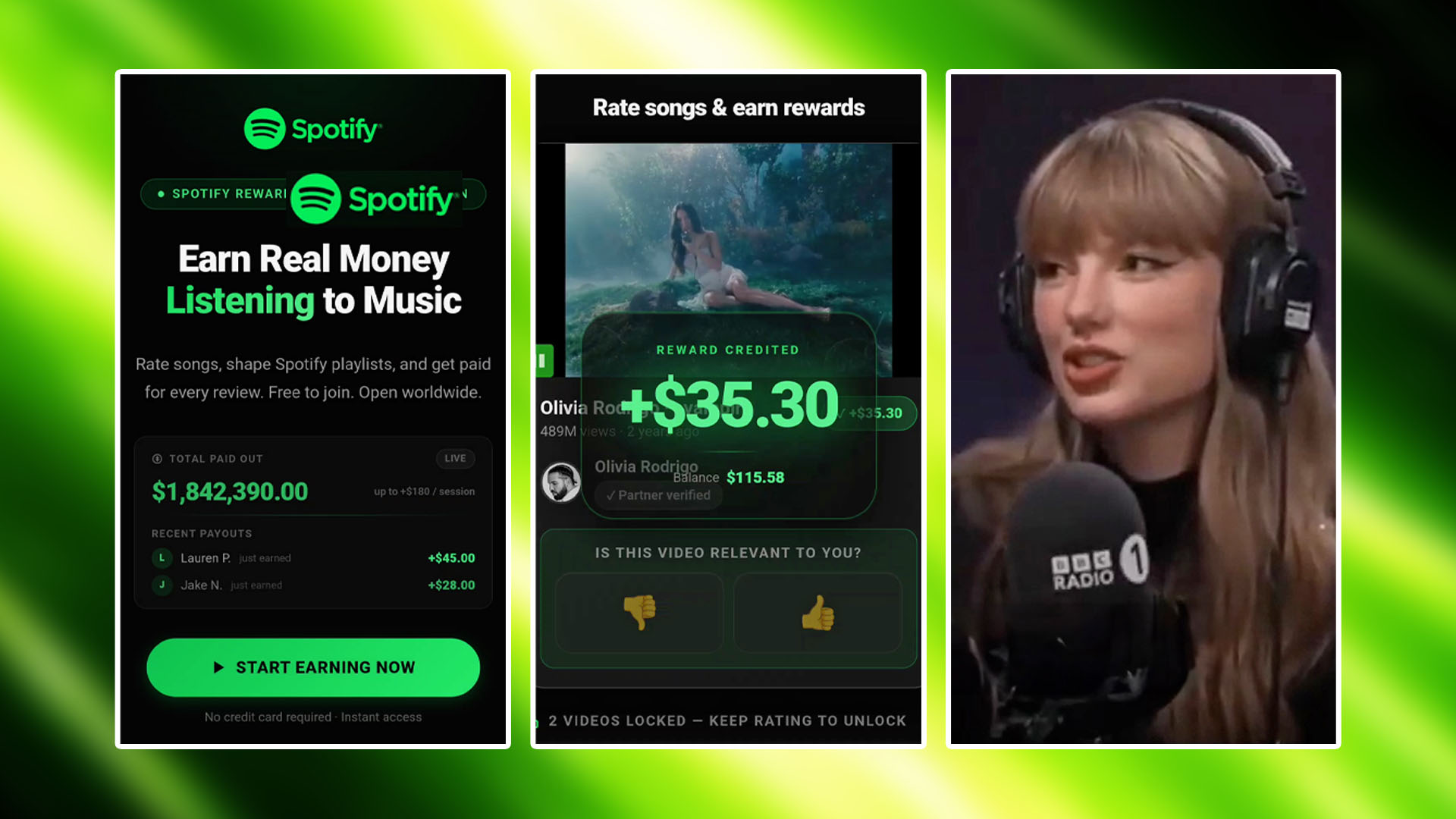
In April 2026, online users searched for a Spotify Rewards Program — as well as “is Spotify Rewards scam or legit” — about an alleged moneymaking system providing big payouts for reviewing songs and ads. Those users looked for login details after viewing scam marketing videos in TikTok scam ads and on websites purportedly showing Justin Bieber, Taylor Swift and other famous people promoting a supposed Spotify Rewards moneymaking program offering users between $100 and $300 a day for only a few moments of their time. The scam ads also featured other people in fake testimonials, none who authentically endorsed or reviewed the product.
In short, Spotify never announced a Spotify Rewards Program for users to login and earn a healthy daily income by reviewing songs and ads. Scammers created deepfake AI and fully-AI depictions of various people — Bieber and Swift included — alleging they provided positive Spotify Rewards Program reviews involving a special way to make and withdraw money. The people behind spotlfyrewards.live, a domain whose owner purposely replaced the “i” in Spotify with a lowercase “l,” knowingly sought to defraud victims via WhatsApp group chats.
An investigation of this product appears below in a recent YouTube video from Jordan Liles, titled, “Spotify Rewards Program — Spotify Rewards Scam or Legit Check.” After that, look for a transcript from my Spotify Rewards Program YouTube video. I advise victims of this scam to report fraud to the FTC and to read up on the Better Business Bureau’s guidance on avoiding falling for money scams.
Transcript from my Spotify Rewards Program YouTube video
Full Video Transcript (Click To Expand)
This video is all about the Spotify Rewards Program. You might be wondering, is the Spotify Rewards Program to make money a scam or legit in terms of being able to rate different songs to make money, lots of money, $100 to $300 a day for you? And it’s a scam. It’s way too good to be true. And this scam has been going around recently for the—for YouTube’s rewards program supposedly, which they don’t have, and as well as a TikTok rewards program.
But I saw this Justin Bieber ad here. Hit play on this. This is about the Spotify Rewards Program scam. This has no—Spotify has no involvement with this, basically, is what I want you to know. And no famous people ever talked about this. Anyone you see talking about this in the videos I’m going to show you, it’s deepfake AI technology, manipulated lip movement with AI-generated vocals.
“They’re paying people to review music. Some participants are earning $100 to $300 per day just by listening to songs and sharing quick feedback. A new tool is allowing listeners to hear short clips from independent artists and answer a few simple questions about what they think of the track. You don’t need to record anything, post online, or show your face. You just listen, give your opinion, and move on to the next song. This helps artists understand what listeners actually enjoy before releasing new music. If you want to check if you qualify, click learn more below, open the survey, and see if there are still spots available.”
And so that ad will then go to spotlfyrewards.live, but it’s not spotifyrewards.live. The URL is spot-l-f-y—it’s like a lowercase “L,” which looks like a capital “I.” So it’s spotlfyrewards.live if you change the “I” in Spotify to a lowercase “L.” And the scammers did that on purpose. This URL was—this domain was registered earlier in March 2026. It’s brand new. Scammers registered it. It has nothing to do with Spotify. Spotify has no involvement.
And just before I continue, please hit the like button down below, the thumbs-up button. That will tell Google and YouTube my video has value and credibility. And that then can save people from being scammed. The more likes I receive, the more views I receive, the more credibility my video has, and then I can save more people from this outright scam, the Spotify Rewards Program. If you’re looking up Spotify Rewards Program reviews, Spotify Rewards Program download, sign in, whatever, withdrawal, or scam or legit, hopefully I can help you out.
And so you can see here, it’s Spotify Rewards Program. You can make a bunch of money, it says here. And so I’m—I’m going to hit “start earning now.” Okay, let’s say that we like that. Sure, why not? Okay, we like that. Sure. And we’re making a lot of money here. Olivia Rodrigo, “Vampire.” Sure. Making a lot of money. Doja Cat. Okay, why not? And then Post Malone. Okay, whatever. And it says, “We have $180 already after doing nothing for 15 seconds.” That is the—I mean, if an online offer seems too good to be true, it probably is. And so, they want you to fill out your information here. And when I saw this last night, I swear I only saw first name, last name, and email address, not phone number, which to me means that the scammers maybe updated this potentially to add phone number. But I’m going to enter some phony information here and hit “withdraw my balance.”
All right, I entered my information. It says, “Watch the video and withdraw your balance. Watch the video below to withdraw your balance.” There’s a video I already watched earlier to try to get an idea of what this was. Hit “watch from the beginning” right now and you can kind of get a sense as to exactly what this is.
“Yeah, not many people know about this new Spotify tool that just launched at the beginning of this year. It actually pays you to evaluate music. Anyone who passes the verification steps can earn money, including by listening to and rating my songs. It’s seriously cool.”
Deepfake. Of course, it’s not actually Taylor Swift talking.
“Regular people can do it from home just using their phone, listen to some tracks, rate them, say which playlist they fit best in, and even give opinions about the ads and the songs they heard. It’s really awesome and innovative. The craziest part is that the pay isn’t low at all. There are people making $100 to $300 a day just doing this.”
“The first thing I did after receiving that money was pay my electricity and water bills that were overdue.”
This is a terrible deepfake. How? Why did the scammers decide to go ahead and put this out there? That’s terrible. The mouth movement doesn’t match and her voice sounds like this.
“I cried with pure happiness. They came to my house again to cut off my service.”
“Two months later, I went and bought the car I had always wanted, paying in cash. Almost no one believed me until it arrived in my garage.”
“I was afraid this wouldn’t work and that I would stop earning. But it’s been over six months now, and the money keeps going into my account, and it’s even more than before. I’m very happy.”
“The only thing I knew how to do on my phone was answer calls and call my daughter. I don’t even really know how to open Spotify to listen to a song. Even today, I still don’t know much and I don’t need to because with just two clicks, I can make money.”
“This is exactly what you just saw on your phone.”
Okay. I don’t know if this guy here, the host or whatever, looks like he’s centered and everything is a real person or if it’s an AI-generated visual of someone, but I can do a reverse image search here in just a second to figure part of that out. “You just need to answer a few questions for Spotify about certain songs and you can earn $100, $200, $300, or even $800 every—using only your phone and internet access. And why does Spotify pay for this? Look, with the massive use of artificial intelligence to automate everything these days, executives at big brands realized it might have been a mistake to try replacing human feelings with machines. Using tons of AI and machines to analyze and rate content like videos and music isn’t just getting insanely expensive because everyone’s using the same tools. It’s also nowhere near as accurate as when a real user says, “This The Weeknd song fits perfectly in the ‘Chill Hits’ or ‘Late Night Drive’ playlist.” That single human opinion is worth more than 10,000 robot analyses.”
I can’t tell who he is. If he’s an AI-generated person, he is. If you know who he is and it’s a deepfake, let me know. If it’s someone who actually did this as a spokesperson for money and they helped to support a scam, let me know that as well. I’ve seen people who are spokespeople online you can hire participate in videos like these even though they’re outright scams and just like—that’s what they do. That’s great.
“On top of that, with the huge increase in online ad competition, brands now want to advertise in premium spots where the platform’s algorithm actually sends the ad to the right people. That’s exactly why Spotify is now paying real users like you and me to evaluate songs and leave honest reviews saying whether the track is good or bad, which playlist it fits best in, which advertisers make most sense for that specific song. By making the ads more premium this way, Spotify can now charge three to five times more for the exact same ad as before simply because it’s being placed in the perfect spot based on real human data. Big investors are already predicting this and it’s pushing Spotify’s stock prices up with much higher revenue forecasts for 2026. Plus, all of Spotify’s competitors—”
Okay, I think I might know who this is based upon a book in the background. At least we can look up the book. So, based on what I can tell, I think that it is a depiction of Brad Gouthro potentially because that’s the person who wrote the book from what I can tell. I’m not saying that he made the video. It could be an—a AI depiction, deepfake AI depiction, or using only AI.
“Now Spotify can officially say our recommendations are made by real humans plus AI. That has become a powerful marketing advantage. Think about it. Huge companies like Coca-Cola, Apple, or Samsung advertise on Spotify every single day. None of them can afford to risk having their ad played before a low-quality song with offensive lyrics or from a controversial—” offensive lyrics. There’s your hint right there. It should be “uhh-ffensive,” right? Because if a word is offensive, maybe it’s vulgar. Now, it’s not “offensive.” And that means I believe it’s an AI-generated voice. “—artist. Imagine a Coca-Cola ad playing right before a song about violence or drugs. That would destroy the brand’s—” could also be face replacement. I know I keep stopping. “—reputation. Spotify needs to make sure that only the best songs, the ones actually loved by real people, get chosen to carry sponsored ads. And for that they need the opinion of regular—” Yeah, he’s got his YouTube reward in the background there. This is, uh, stolen video is what it looks like to me. “—is what saved many people from financial suffocation including me. I can say it changed my life overnight. Look, this is what I had in my account before and this is the balance I have today. And I’ll tell you more. If I who was a supermarket cashier—” that looks like an AI-generated image. Anyway, we don’t need to keep watching. “—with no education or experience to do it.”
So, the video will finally end and then it’ll give you access to this button here, “Access Spotify Rewards.” And I believe—I could be wrong, but I believe at a certain point they talk about in the video there being a WhatsApp group chat or something like that. And that is what normally happens with these things is that they take you somewhere and they want you to trust it and that’s where they get your money and they’re going to be—they’re going to say, “Well, you know, give us your financial information. We promise just a few seconds later, a few minutes later, you’re going to get your rewards. We just need your financial information,” which is like obviously they’re trying to scam me. Obvious to me, not obvious to everyone. “Access Spotify Rewards.” Where does it take us? To Digistore24 and it’s called “Acess Rewards” here with one “C.” This is probably coming from Brazil is my guess, which is not a big surprise if so. And I don’t see any other information here about the supposed company or anything because this is—it might not be coming from Brazil. Might be coming from someone hiding in Florida or California or somewhere in the Midwest. I don’t know. But hopefully that person is found. So like, comment, subscribe. The Spotify Rewards Program is not legit. Spotify does not offer a rewards program to make money. And so if you see Spotify Rewards Program scam or legit, Spotify Rewards Program reviews, if you want to know more about this, hopefully I helped you stay away from this. If you did fall for this, call your credit card company immediately and report fraud. It is a—a fraudulent scam. Absolutely 100%. Like, comment, subscribe. The join button is down below. Thank you for watching.